



Table of contents
Sustainable Aviation Fuel, carbon offsets and electric aircraft: Here's an honest look at what the industry is doing to cut emissions and how far it still has to go.
If you’ve flown recently, you may have seen growing talk of “sustainability” splashed across airline ads, aviation marketing and headlines about the future of travel. Electric planes! Carbon-neutral flights! Cleaner skies! It all sounds promising until you stop, think critically and ask, “Is aviation actually getting greener, or is this simply misplaced optimism?”
In actuality, flying really is beginning to take a greener, and brighter path. Aviation still accounts for roughly 2 to 2.5% of all global carbon dioxide emissions, and its total climate impact is even larger when you factor in high-altitude effects like contrails and atmospheric warming. At the same time, aviation is one of the hardest industries in the world to decarbonize. Unlike cars, commercial aircraft cannot simply swap gasoline for giant rechargeable batteries overnight.
But something important is changing. In response to climate change and growing resource shortages, airports, airlines and aircraft manufacturers are investing in cleaner fuels, more efficient fleets and new technologies designed to reduce emissions over time. Some of those changes are still years away. Others are already underway at aviation hubs like Ontario International Airport (ONT).
So no, flying is not suddenly “green.” But the industry is evolving in ways that signal a better, more climate-friendly future of travel.

Flying Still Has a Carbon Problem
Commercial aviation moves millions of people safely and efficiently every day, but it comes with a real environmental cost. Aircraft burn large amounts of jet fuel, especially during takeoff and climb, while demand for air travel continues to grow worldwide.
That growth presents part of the problem, because aviation is uniquely difficult to electrify at scale. Batteries remain far heavier than jet fuel relative to the amount of energy they provide, and a commercial jet carrying hundreds of passengers across continents simply cannot run on current battery technology without sacrificing enormous amounts of range and payload capacity.
After road transportation, aviation is the second-largest source of greenhouse gas emissions in the transportation sector, but there are additional climate impacts beyond carbon dioxide alone. Contrails and other high-altitude atmospheric effects contribute additional greenhouse warming that researchers continue to study closely. In simple terms, aviation’s environmental footprint is larger than many travelers realize.
While emissions issues in aviation have yet to be solved, the industry has largely stopped pretending that efficiency improvements alone will be enough. Airports and airlines are now investing in measurable strategies that can reduce emissions today while longer-term technologies continue developing for the future.
The Fuel That Could Change Flying
One huge thing shaping the future of aviation right now is “SAF.” No, we’re not talking about the Santa Fe Regional Airport, but rather “Sustainable Aviation Fuel.” Rather than being some futuristic rocket fuel or something Doc Brown cooked up, this is a lower-carbon alternative to traditional jet fuel made from non-petroleum sources such as used cooking oil, agricultural waste, fats, greases, woody biomass and even certain forms of municipal waste. One of the coolest and most important parts is that SAF works with today’s aircraft and fueling systems, so airlines don’t need entirely new planes or expensive retrofits to use it.
Depending on the materials used and the production process, SAF can reduce lifecycle greenhouse gas emissions by up to 80% compared to conventional jet fuel. While it doesn’t eliminate emissions completely, it can significantly reduce them without requiring massive infrastructure changes across the global aviation system.
Still, there are challenges. SAF remains more expensive than traditional jet fuel, and the current supply is still limited relative to global demand. But adoption is steadily growing as airlines, airports and fuel suppliers scale production and partnerships.

The Industry Is Changing in Smaller, Smarter Ways
Most airline sustainability progress is less flashy than people expect. Instead of waiting for a single, Jetsons-esque breakthrough technology, the industry is attacking emissions from multiple angles at once.
Newer aircraft models are dramatically more fuel-efficient than older generations, and airlines continue to retire aging fleets in favor of lighter, more aerodynamic planes that burn less fuel per passenger. And since ground transport can rely on battery power, airports are electrifying ground equipment to improve taxi operations and reduce unnecessary idling time for aircraft on the tarmac.
Insider Scoop: ONT continues to electrify its ground transportation and support equipment, with emissions-free shuttles, a new EV truck, electric-powered units to cool planes at gates and more.
Route planning has also become more sophisticated, and better navigation systems and more efficient flight paths have reduced fuel burn over thousands of flights every year. Even seemingly small improvements like this matter in a big way at an aviation scale.
Some airlines also offer carbon offset programs that allow travelers to financially support environmental projects designed to reduce or capture emissions elsewhere. These programs remain controversial because offset quality varies significantly, but many experts see them as a supplemental tool rather than a complete solution.
A Local Example: SAF at ONT
ONT is committed to making flying better for everyone, including our environment and the future generations who deserve to enjoy it!
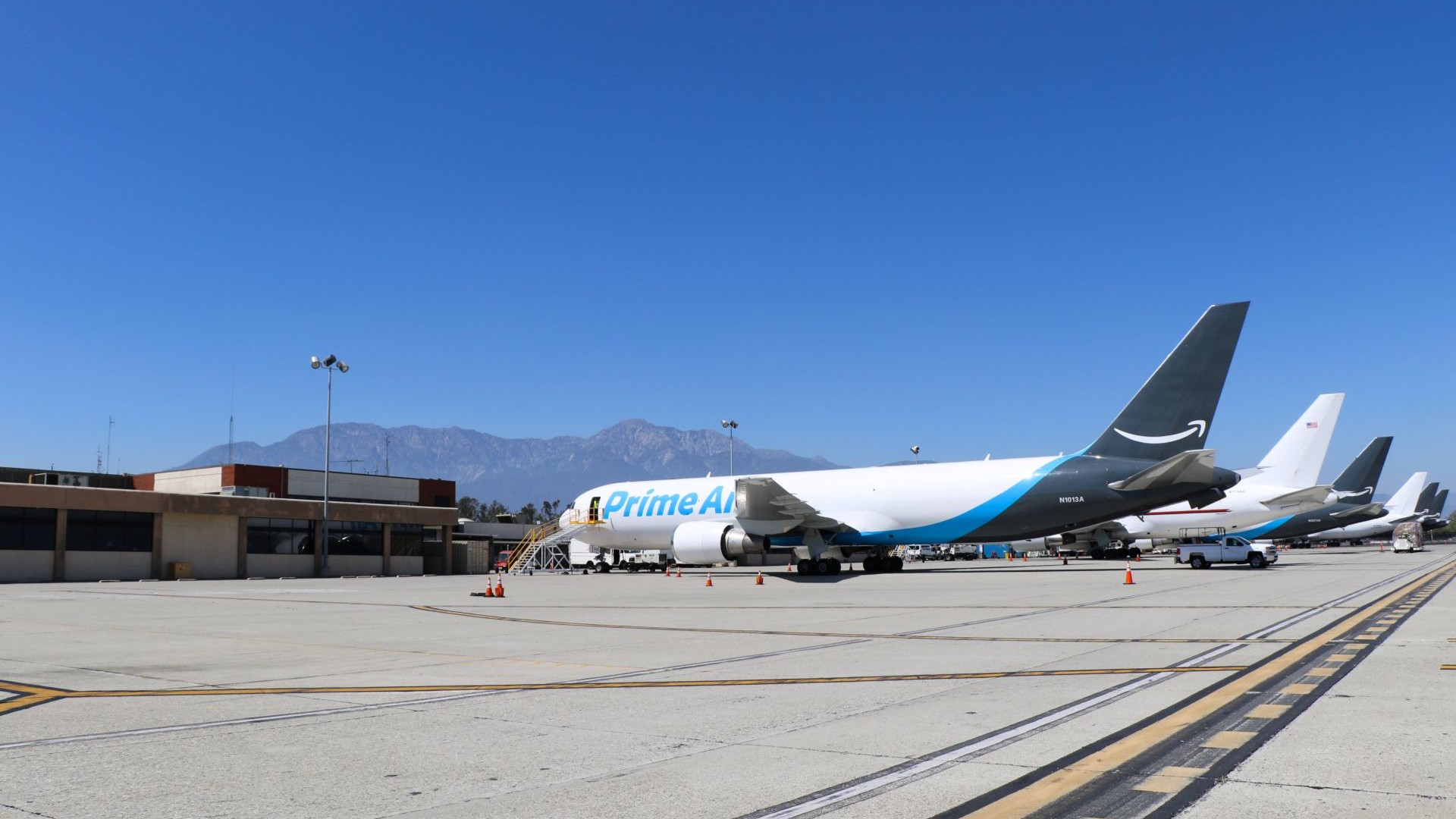
In late spring of 2025, Amazon Air became the first carrier to use Sustainable Aviation Fuel at ONT through a partnership with fuel producer Neste. The agreement brought approximately 2.5 million gallons of SAF into Amazon Air operations connected to ONT and San Francisco International Airport, marking a significant milestone for cleaner fuel adoption in the region.
Most travelers passing through ONT likely had no idea this was happening behind the scenes, but that was never the goal. Bringing lower-carbon fuel options to more airports creates momentum for broader industry adoption and helps build the supply networks needed to scale cleaner aviation technologies nationwide.
For ONT, it also reinforces the airport’s broader role in supporting smarter transportation infrastructure and forward-looking operational improvements across Southern California.
Carbon Offsets: Helpful Tool or Clever Distraction?
Carbon offsets tend to spark strong opinions because they sit in a complicated gray area regarding environmental impact.
In theory, offsets allow travelers or airlines to balance emissions by funding projects such as reforestation, renewable energy or methane capture initiatives elsewhere. Some programs are independently verified and tied to measurable environmental benefits. Others are far less transparent, further validating the caution many sustainability experts preach against viewing offsets as a “get out of guilt free” card for flying.
The more balanced perspective is that offsets can play a supporting role when paired with actual emissions reductions like SAF adoption, operational efficiency improvements and cleaner technologies. Offsets alone cannot solve aviation’s climate challenges, but credible programs may still contribute positively when used responsibly. A small positive impact is better than none, after all.
Still, consumers should be careful when evaluating these programs for travelers interested in offsetting flights; transparency matters. Look for programs that clearly explain how projects are verified, monitored and retired rather than vague promises about maybe planting trees somewhere someday.
The Electric Plane is Real, but Still Far Off
If you imagined fleets of giant battery-powered passenger jets arriving in the next decade, you’re thinking a little too optimistically. And yet, electric aviation is absolutely being developed. Companies like Heart Aerospace are actively testing electric aircraft concepts and short-haul regional models. But large-scale commercial electric flying faces a major obstacle: batteries are extremely heavy.
Jet fuel stores far more energy per pound than current battery technology — plus, it depletes with use, offsetting its own weight-to-fuel-expenditure ratio. This is why fully electric long-haul commercial aircraft remain impractical for now. Even optimistic projections suggest widespread electric aviation at a meaningful commercial scale is likely decades away.
But this doesn’t mean progress isn’t happening! Smaller electric aircraft could become viable for regional routes, commuter flights and training operations much sooner. Hybrid technologies may also help bridge the gap over time. Though if you board a commercial flight tomorrow or in the coming years, the greener future you’re most likely to participate in will involve SAF and improved efficiency, not fully electric propulsion.
Small Choices Travelers Can Make Right Now
Individual travelers are not solely responsible for fixing aviation’s environmental challenges, but there are still many practical ways to reduce your own flight footprint.
Choosing nonstop flights when possible can help because takeoffs and landings are among the most fuel-intensive parts of air travel. Supporting airlines that publicly invest in SAF programs or fleet modernization also encourages continued industry investment in lower-emission operations. Packing lighter can make a small difference in airline fuel usage, as well. One suitcase may not seem important, but weight adds up quickly across thousands of passengers and flights.
And while no airport or airline can make flying entirely carbon-free today, travelers can still support organizations actively investing in smarter long-term solutions rather than ignoring the problem altogether.
Looking to make an immediate impact? You can donate today to assist our natural spaces and global communities which are the least responsible for the climate crisis and yet suffer its consequences the most.
Flying into a More Sustainable Future, Together
Unless tomorrow’s Einstein makes an incredible breakthrough, the future of greener aviation is probably not arriving in one dramatic moment. Instead, we’ll achieve sustainability through thousands of gradual improvements layered together over years and decades of good faith and hard work. We’ll start with cleaner fuels made from recycled materials, more efficient aircraft, better infrastructure, smarter routing and new tech becoming more practical with each iteration.
That all may sound less exciting than futuristic electric jets silently moving through clear skies, but this is how meaningful industry change often works. Progress tends to look slow until suddenly we all become aware of how much it’s mattered.
At ONT, we’ve been a frontrunner in shaping greener airport operations, and for travelers watching the future of aviation unfold, our commitment will always remain steady.



Contact ONT
Have questions for the ONT team? Click the link below for multiple ways to connect with us.