


Table of Contents
Most security holdups aren't about dangerous items; they're about stuff people packed without thinking. Here's what TSA flags and why.
“Wait… that’s not allowed?”
Nobody walks up to the security checkpoint thinking, “Gee, I sure hope they take my stuff today.” And yet, every single day, scores of travelers watch helplessly as TSA officers pull their bag aside, root through it and remove… a snowglobe. Or a wheel of cheese. Or a full-sized bottle of very expensive leave-in conditioner that now lives in the airport trash can.
Most people getting items flagged or confiscated at security aren’t smugglers, they’re accidental rule-breakers. They're a mom who didn't realize her toddler's juice box counted as a liquid, a guy who packed his camping trip straight into his carry-on without thinking twice about the multi-tool, and the innumerable people every day who are genuinely surprised to learn that peanut butter is, by TSA standards, a liquid (We know. We're sorry. It's thick. It's a paste. It defies categorization. And it cannot exceed 3.4 oz.).
The rules aren't always intuitive. They change often, and some of them you might only know if you’ve already made the mistake. This guide won't judge you for not knowing, it'll just make sure you're not the person at the checkpoint learning the hard way.
Looking for even more advice? Check out our First Time Flyer Guide!

The 3-1-1 Rule (AKA the One Everyone Half-Remembers)
If there’s one rule that trips people up the most, it’s this one. At a glance, it’s pretty straightforward:
- Carry-on liquids, aerosols and gels must be in containers 3.4 ounces (100 ml) or smaller
- All liquid containers must fit in one clear, quart-sized bag
- Each passenger gets one bag
Simple in theory; somewhat tricky in practice. One big thing to remember is that size actually matters more than how full something is. An oversized shampoo bottle that’s “basically empty” still won’t make it through. TSA looks at the container, not the contents. Unless it’s a completely empty bottle, it’s getting pulled.
There are a few important exceptions. Medically necessary liquids, baby formula and breast milk are allowed in larger quantities, but you’ll need to declare them at the checkpoint. TSA also says that even if an item is usually permitted, anything may be subject to additional screening or removal if it triggers an alarm, appears to have been tampered with or poses security concerns.
Read More: How to Pack Like a Pro with Just a Carry-On

Things You Didn't Know Count as a Liquid
When TSA talks about “liquids,” they don’t just mean anything with the consistency of water or oil. They’re also looking at anything spreadable, squeezable or gel-like. Remember learning about the states of matter in school? If it isn’t totally solid, gaseous or burning hot plasma, it’s a liquid. That includes:
- Peanut butter
- Yogurt
- Hummus
- Salsa
- Jam or jelly
- Soft cheeses
- Gel deodorant
- Hair pomade
- Some cosmetics
If it can’t hold its shape outside a container or is spreadable, there’s a good chance TSA considers it a liquid.
This is why snacks can be surprisingly risky. A granola bar? Totally fine. A container of yogurt? Now you’re negotiating with the 3-1-1 rule.

What TSA Says About Food
Speaking of snacks, most solid food is allowed in your carry-on. Sandwiches, chips, nuts, fruit, cookies — all that good stuff is no problem. You can bring food through security and onto the plane without issue (though many food items will not be allowed through international customs upon arrival).
Where people get tripped up here is with mixing liquids/gels with solids. That PB&J sandwich with extra J is fine, but a sandwich bag that’s more jelly than sandwich will follow liquid rules. Soup, sauces and dips all fall into the same category. Basically, just use your best judgement.
Frozen food gets a special mention. It’s allowed, but only if it’s completely frozen solid when you go through security (and preferably in an air-tight, leak-proof container). If it starts to melt or becomes slushy — you guessed it — security now considers it a liquid, and it becomes governed by the 3-1-1 rule.
If you’re traveling with kids or packing snacks for a longer trip, it’s worth double-checking what falls into which category.
Electronics, Batteries and the Rule Most People Miss
Here’s a category that causes issues because everyone assumes it’s so straightforward.
Laptops, tablets and larger devices typically need to be removed from your bag during screening unless you’re enrolled in TSA PreCheck. Smaller items like phones can stay put.
Batteries, however, are where a lot of travelers get caught off guard. Lithium batteries, found in most modern electronics, must go in your carry-on, not your checked bag. This includes power banks and spare batteries.
Why is this rule the opposite of all the others? Safety. If a battery overheats or malfunctions, it’s much easier to address in the cabin than in the cargo hold. So if you’ve been tossing your charger pack into your checked luggage, it’s time to rethink that move.
Medications: What TSA Actually Allows
Good news for travelers with medical needs: TSA rules around medications are generally more flexible than people expect. Prescription medications, over-the-counter medicines, vitamins and supplements are all allowed in both carry-on and checked baggage. Pills and tablets do not need to fit within the 3-1-1 liquid rule, which surprises a lot of people the first time they fly.
Liquid medications are also exempt from standard liquid limits when they are medically necessary, even if the container is larger than 3.4 ounces. TSA simply asks that you notify the officer during screening if you’re carrying medically necessary liquids, gels or aerosols. The same applies to items like saline solution, insulin, refrigerated medications and liquid pain relievers for children.
Medications should be kept in original labeled containers whenever possible, especially prescription drugs. While TSA does not require it in most cases, having labels visible can help avoid confusion during screening and make life much easier if you’re traveling internationally. And one more important tip: always pack essential medications in your carry-on, never a checked bag. Lost luggage is stressful enough without losing your allergy medication halfway through a trip.
Read More: TSA Medical Rules
What Has to Go in Checked Baggage
“My uncle who never flies had a multi-use tool confiscated because it had a little knife on it. He tried to bring it to Italy for the corkscrew!” — ONT Staff Member
Some items are a hard no for carry-ons, even if they seem harmless at first glance.
Sharp objects are the most obvious (despite being the most-confiscated item by TSA). Knives, scissors, safety razors and, yes, that tiny blade on your multi-tool will all get flagged.
Other commonly confiscated items include:
- Anything that can be construed as a weapon (from knives to hatchets to multi-tools)
- Large or sharp sporting equipment (even darts)
- Certain tools
- Firearms and ammunition (which have very specific rules and must be declared properly)
Sometimes a mistake at security is caused by simply forgetting what’s been living in your luggage for years. When in doubt, check your bag, or better yet, check the official TSA guidelines before you pack.
Travel Tip: Getting caught with a prohibited item usually just results in you having to throw it out or let it be confiscated, but other times the penalty can be more serious. Know the rules, and always double-check your bags.
If You Have TSA PreCheck, Things Get Easier
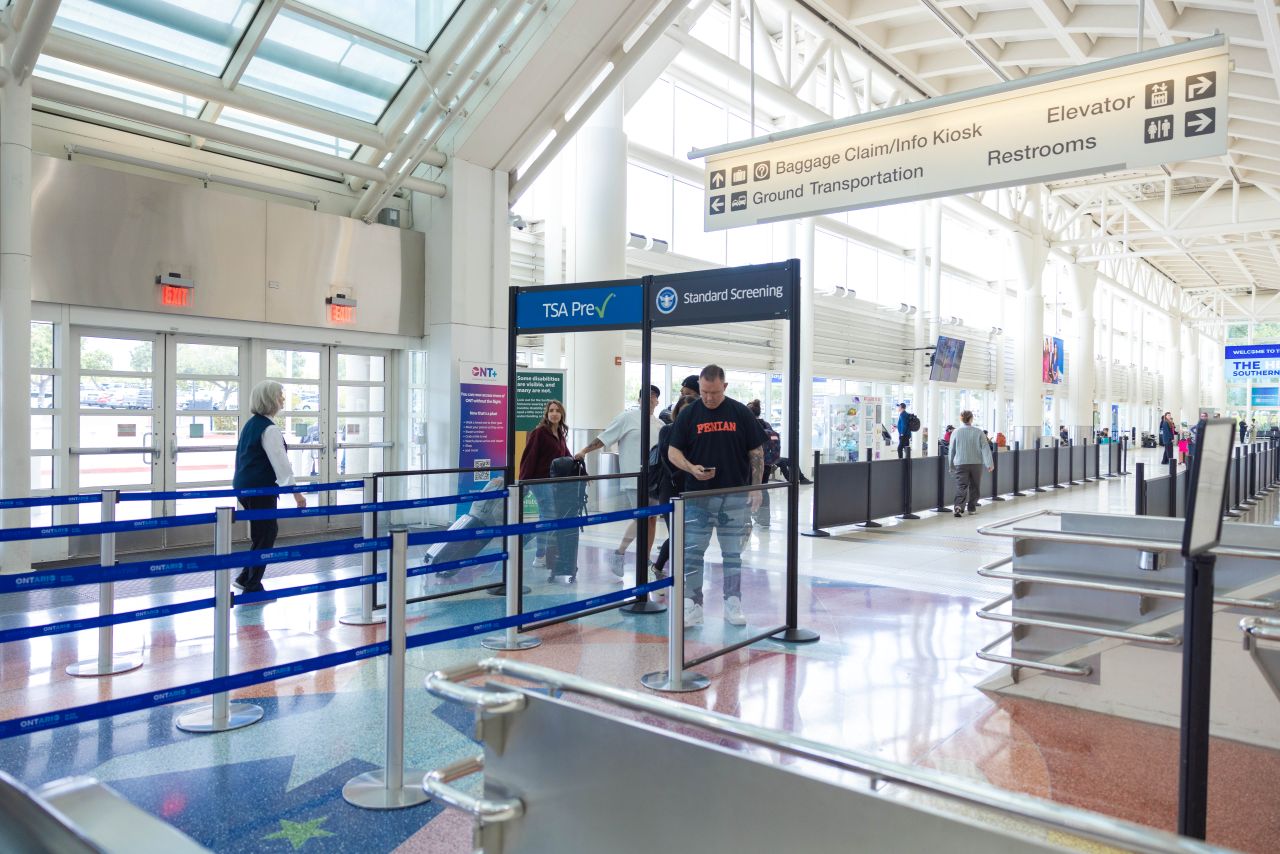
TSA PreCheck doesn’t change what you can bring, but it does change how you move through security.
With PreCheck, you don’t need to remove belts, shoes, laptops or liquids from your bag. It’s a faster, more streamlined process designed for frequent travelers, but the core rules still apply. That giant bottle of maple syrup still won’t make it through, even if it stays in your bag.
Programs like CLEAR can also help speed up the identity verification part of the process, though availability varies by airport.
One More Thing Before You Head to ONT Security
If there’s a theme here, it’s this: Most TSA hiccups are entirely preventable. A quick bag check and rule review before you head out the door can save you time, stress and the mild embarrassment of having your belongings inspected in front of a line of strangers (or a potential fine).
If you’re flying through Ontario International Airport (ONT), you’re already starting with a leg up. Security lines tend to move quickly, and the overall experience is designed to feel less chaotic than larger airports. That said, knowing what to expect still makes a big difference.
Before you head out, take a moment to check current security wait times so you know exactly what’s going on when you arrive at ONT. It’s one of the simplest ways to stay ahead of the rush and keep your travel day running smoothly from the very start.
Good luck, and safe travels!

Trending Posts

Contact ONT
Have questions for the ONT team? Click the link below for multiple ways to connect with us.